

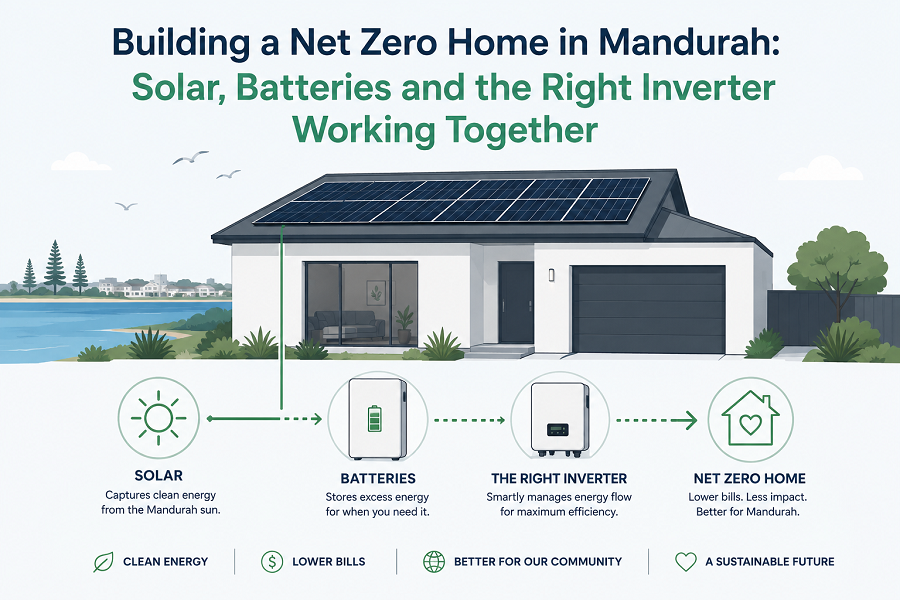
The term net zero gets used loosely in conversations about home energy, but the practical meaning is straightforward: a home that generates as much energy as it consumes across a year, using the grid as a buffer rather than a primary source. For most Australian households, this was a theoretical aspiration a decade ago. In Mandurah, with its exceptional solar resource and the current state of solar and battery technology, it is an achievable reality for a growing number of homes.
Reaching genuine net zero energy status requires three things working together: a solar system sized to generate sufficient annual energy, battery storage to shift generation into consumption periods, and an inverter platform sophisticated enough to manage the energy flows between these systems intelligently. Getting any one of these elements wrong undermines the performance of the whole.
This guide is for Mandurah homeowners who want to understand the integrated system design that a net zero or near-net-zero energy home requires, what the current technology options look like, and how to approach the design process in a way that delivers the outcome rather than just the components.
What Net Zero Actually Requires in Practice
A net zero home in Mandurah needs to generate, on an annual basis, approximately what it consumes from the grid. This sounds simple but requires careful planning because generation and consumption do not naturally align.
Solar generation peaks in the middle of the day in summer. Household consumption typically peaks in the morning and evening. Without storage, a household exports surplus midday generation at the low feed-in tariff and then imports grid electricity at the higher retail rate during the hours when solar is not generating. This mismatch is what prevents a household with a large solar system from achieving net zero status even when the annual generation nominally equals the annual consumption.
Battery storage resolves this mismatch by capturing the midday surplus and releasing it in the evening. A well-sized battery system, combined with a sufficiently large solar array, can dramatically reduce the household’s grid imports and move it toward genuine net zero status.
The specific system size required depends on the household’s consumption profile. A household that consumes 20 kilowatt-hours per day across the year needs a solar system capable of generating approximately 20 kilowatt-hours per day on average, with battery storage sized to bridge the gap between daytime generation and evening consumption.
Why the Inverter Is the Integration Point
In a net zero system with solar and battery, the inverter is not simply a conversion device. It is the intelligence centre that manages energy flows between four systems: solar generation, battery storage, home loads, and the grid.
A conventional grid-connected solar inverter handles only the conversion of solar DC to grid AC. It cannot manage battery charge and discharge cycles. A hybrid inverter, by contrast, combines the solar inverter and battery inverter functions in a single device and adds the energy management logic that determines how to allocate electricity between the battery, the home, and the grid at any given moment.
For Mandurah homeowners planning a net zero system, this energy management logic is where the quality difference between inverter platforms becomes financially meaningful. A sophisticated energy management system can:
- Prioritise battery charging from solar during midday surplus
- Sell battery-stored electricity back to the grid during Western Power’s peak DEBS rate window
- Pre-charge the battery from cheap off-peak grid electricity when that is economically advantageous
- Shift flexible loads such as hot water heating to align with solar generation peaks
For Mandurah households considering professional Fronius solar inverter installation as the management hub of a net zero system, the monitoring and energy management capability of this platform provides the data transparency and control sophistication that a net zero strategy requires.
Solar Array Sizing for a Net Zero Mandurah Home
Sizing the solar array for net zero performance requires starting from the household’s actual annual consumption rather than from available roof space.
The average Australian household consumes approximately 20 kilowatt-hours per day, though Mandurah households with ducted air conditioning running through a long summer cooling season can be significantly higher. A household that consumes 8,000 kilowatt-hours per year needs a solar system generating approximately 8,000 kilowatt-hours net of system losses.
In Mandurah, a quality 6.6-kilowatt solar system generates approximately 9,500 to 10,500 kilowatt-hours per year on a well-oriented roof. A 10-kilowatt system generates proportionally more, approximately 14,000 to 16,000 kilowatt-hours annually. For many Mandurah households, a system in the 10-kilowatt range with adequate battery storage can achieve net zero status across the full year.
The 5-kilowatt single-phase export limit applied by Western Power does not affect the total system size available. It only limits instantaneous grid export to 5 kilowatts. A larger solar system exports at 5 kilowatts when export is occurring while running higher loads within the home from solar. Battery charging can also absorb solar generation that cannot be exported.
Battery Sizing for Net Zero Ambitions
The battery’s role in a net zero system is to bridge the gap between solar generation hours and consumption hours. The appropriate battery capacity is one that captures the daily solar surplus without being so large that it frequently does not fully charge.
For a Mandurah household targeting net zero, a battery in the 10 to 15 kilowatt-hour range typically provides meaningful overnight coverage through most of the year, with the solar system reliably recharging it each day. In winter, when generation is lower and heating loads may be higher, the battery may not provide full overnight coverage every night, which is where the grid connection provides backup security.
The solar battery in Mandurah cover a range of capacities from entry-level systems through to whole-home storage configurations. The right capacity for a specific household depends on the evening consumption profile, the solar array size, and how closely the household wants to approach complete grid independence.
It is worth being realistic about the economics of very large battery systems. The marginal financial return on battery capacity diminishes beyond the amount needed to cover typical overnight consumption. Oversizing the battery to achieve occasional grid independence during poor weather days returns the investment much more slowly than the core storage that handles the majority of evenings.
The Role of Smart Loads in a Net Zero System
Beyond solar, batteries, and inverters, a net zero home leverages flexible loads to increase self-consumption and reduce the mismatch between generation and demand.
Hot water heating is the most impactful flexible load in most households. A heat pump hot water system with timer functionality, programmed to heat during peak solar generation hours, converts midday solar surplus into stored thermal energy at high efficiency. This reduces both grid imports in the evening and midday solar exports at the low feed-in rate.
Electric vehicle charging represents the next generation of flexible load management. An EV charged from midday solar generation rather than from the evening grid dramatically increases self-consumption and is an increasing reality for Australian households as EV adoption grows.
Dishwashers and washing machines can be shifted to run during solar generation hours using simple timers. While individually modest in energy terms, the combined effect of shifting these loads to solar generation hours contributes meaningfully to self-consumption across the year.
The net zero home is not just about the generation assets. It is equally about managing consumption in relationship to generation.
Getting the System Designed Properly
The complexity of a net zero system design, accounting for consumption profiles, generation potential, battery sizing, inverter selection, and load management, means that an off-the-shelf package is rarely the right answer. Genuine net zero performance requires a design that starts from the household’s specific situation.
A proper solar panel installation in Mandurah designed for net zero ambitions should include a site assessment that covers roof orientation and available area, shade analysis, consumption data review from electricity bills or smart meter data, and modelling of the proposed system’s annual generation and self-consumption performance.
The output of this process should be a system design with documented performance projections, not a catalogue selection of components at an attractive price.
Conclusion
Net zero energy status for a Mandurah home is achievable with currently available technology at economics that make the investment defensible. The exceptional solar resource of the Peel region, combined with quality solar, battery, and inverter technology, creates the conditions for a home that contributes as much energy as it takes from the grid across a full year.
The path there requires a design approach that treats solar, storage, and energy management as a single system, not separate products. Get that integration right and the net zero home is not an aspiration. It is a well-designed engineering outcome.
