

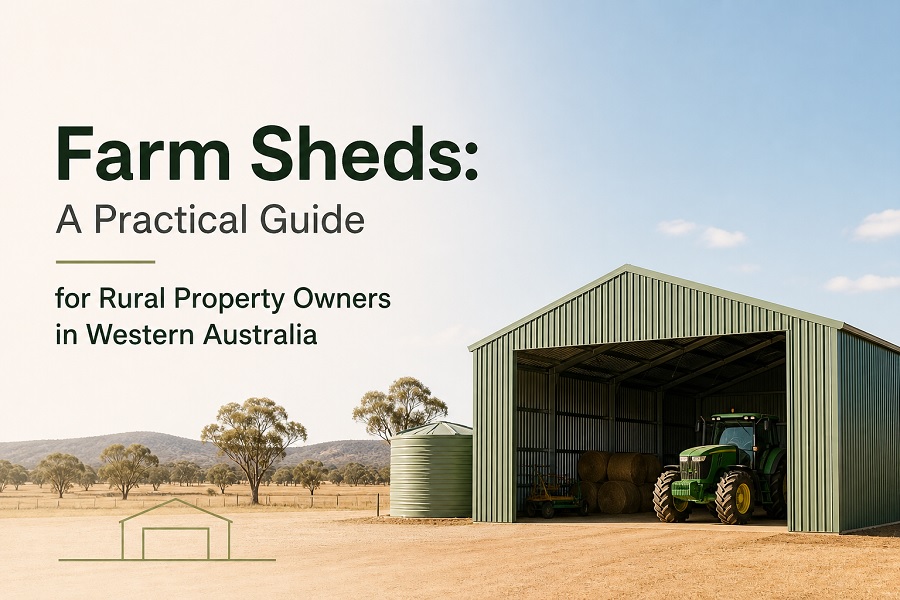
For anyone running a farm, hobby farm, or rural property in Western Australia, a reliable farm shed isn’t a luxury — it’s core infrastructure. Equipment left exposed to the elements deteriorates quickly. Grain and feed stored in inadequate conditions results in costly spoilage. Machinery that can’t be serviced undercover during harvest creates delays at the worst possible moment.
Farm sheds are purpose-designed to meet these demands. Unlike residential sheds or standard garden structures, a farm shed needs to accommodate large machinery, handle significant structural loads, withstand WA’s weather extremes, and be flexible enough to serve multiple functions at once. Whether you’re harvesting crops on broad-acre land or running a mixed operation on a small rural block, having the right shed in the right place pays dividends every single season.
In this guide, we cover the key considerations for rural property owners — from design and sizing through to materials, council approvals, and how to get the most out of your investment.
What Sets Farm Sheds Apart from Standard Residential Structures
The distinction between a farm shed and a standard residential shed goes well beyond size. Farm sheds are working structures — they need to handle demands that would overwhelm a typical backyard build.
Machinery access: Tractors, harvesters, sprayers, and their implements can be surprisingly large. Doorway height and width are critical design considerations for any serious farm shed. A shed that can’t comfortably accommodate your largest piece of equipment becomes an obstacle rather than an asset — particularly during time-sensitive operations like harvest or seeding.
Structural loads: Heavy machinery and bulk storage put significant stress on shed floors and frames. Rural sheds are typically engineered to handle higher point loads and distributed loads than residential structures, and the structural design needs to reflect the actual equipment and materials that will be used inside.
Multi-function capability: A well-designed farm shed serves several purposes simultaneously — machinery storage, a workshop area, chemical storage in a compliant and segregated bay, and sometimes livestock shelter. Planning for multi-functionality from the start means you’re not building separate structures for every operational need.
Long-term durability: Rural environments are harsh. Dust, moisture, wind, and year-round UV exposure put constant pressure on building materials. Farm sheds need to be built to last without requiring ongoing maintenance attention that takes time away from the actual work of running a property.
Getting the Size Right for Your Rural Property
Undersizing is the most common — and most costly — mistake in farm shed planning. The shed that seems large enough when you build it fills up faster than expected, and adding on later is always more expensive than building bigger from the start.
When sizing your farm shed, think through these questions carefully:
– What is the largest piece of machinery you currently own — and what might you add over the next five to ten years?
– Will you need to drive through the shed — in one end and out the other — or is single-end access sufficient?
– Do you need separate bays for different categories of equipment or function?
– Will the shed be used for grain or bulk storage? If so, what volume, and will you need clearance for delivery vehicles?
A practical starting point for most mixed-use farm sheds is a minimum bay width of 9 —12 metres and a door height of at least 5.4 metres to accommodate modern equipment. For larger operations, clear-span designs — with no internal columns — provide maximum flexibility and are worth the additional engineering cost. Once you’ve worked around internal columns while manoeuvring a header or a loader, you understand exactly why clear-span matters.
Materials and Construction for WA’s Rural Conditions
Western Australia’s rural areas present some of the most demanding conditions for outdoor structures anywhere in Australia. Inland regions experience extreme heat, dust, and dramatic temperature swings between day and night. Coastal and south-west properties deal with higher rainfall and salt air corrosion. The right material choices make a substantial difference to long-term durability.
Structural steel
High-tensile steel is the dominant framing material for farm sheds in WA, and for good reason. It offers the strength-to-span ratios needed for wide, clear-span structures, resists termites, and holds up well under harsh conditions when properly treated. Galvanised framing provides superior corrosion resistance compared to painted-only finishes — worth specifying in coastal or high-humidity environments along WA’s south-west and Great Southern regions.
Roof and wall cladding
Colorbond steel is the most widely used cladding material for rural sheds and farm properties across WA. It’s durable, low maintenance, and available in colours that reflect rather than absorb heat — an important consideration for sheds in the Wheatbelt, Goldfields, or regions where summer temperatures regularly exceed 40°C. Lighter colours can reduce interior temperatures meaningfully during the hottest months.
For chemical storage bays or areas exposed to fertiliser, spray residue, or other agricultural chemicals, additional corrosion-resistant treatments on both the structure and fasteners extend the lifespan of those sections significantly. It’s a relatively small additional cost that prevents premature deterioration in the most chemically active part of the shed.
Concrete slabs and footings
The slab is the foundation of everything. For farm sheds, slabs need to be engineered for the specific loads they’ll carry. A fully loaded grain truck or a heavy tractor with a front-end loader exerts very different forces to a standard car — and a slab designed for the latter will crack under the former. Engage an engineer to design the concrete slab if you’re in any doubt about load requirements, and ensure the design accounts for any future equipment you may add.
Planning and Approvals for Farm Sheds in Western Australia
Rural and agricultural land in WA operates under different planning frameworks to residential land, and the rules around shed construction can be more permissive — but they still need to be followed carefully before a slab is poured.
Planning approval: On land zoned rural or agricultural, many farm sheds are permitted development or processed as straightforward approvals. The key factors are the shed’s size relative to the lot, its intended purpose — primary production versus ancillary residential use — and its proximity to property boundaries and public roads. Larger structures, particularly those intended for commercial-scale operations, may require a more detailed assessment.
Building permits: A building permit is typically required regardless of whether planning approval is needed. For larger farm sheds, an engineered design submitted with the permit application demonstrates compliance with wind load requirements — particularly relevant in coastal areas and the agricultural regions of WA — as well as structural and safety standards.
Chemical storage compliance: If your farm shed will include a bay for agricultural chemicals, herbicides, or fuels, specific compliance requirements apply under WA’s dangerous goods and environmental regulations. A segregated, bunded chemical bay with appropriate ventilation and spill containment is both a regulatory requirement and a genuine safety essential. Treating this as an add-on rather than an integrated design element often creates problems during the approval process.
Your local shire’s planning department is the right first contact for any farm shed project — most are experienced with agricultural building applications and can provide clear guidance on what’s required in your area.
Design Features Worth Including from the Start
The design decisions you make before construction are far cheaper than modifications after the build. These are the features most experienced rural property owners wish they’d included from day one.
Drive-through layout: If there’s any possibility you’ll need to drive through the shed — with a tractor and large implement, for example — design for it upfront. A drive-through shed with roller doors at both ends is considerably more useful than a single-entry structure when you’re working under time pressure during seeding or harvest.
Lean-to additions: A lean-to off the main shed structure is one of the most cost-effective ways to add covered space. It can shelter smaller equipment, provide a covered working area, or house a chemical storage bay without adding to the main shed’s footprint or significantly increasing the overall cost.
Three-phase power: Installing three-phase power to a farm shed opens up a much wider range of machinery and equipment options — welders, air compressors, grain augers, irrigation pumps, and more. Plan the electrical layout before the slab is poured to allow for conduit installation, and work with a licensed electrician on the design from the outset.
Water catchment: Most farm sheds sit on large roof areas that can collect substantial amounts of rainwater. Connecting your shed roof to a rainwater tank adds a practical on-site water source for shed cleaning, vehicle washing, fire suppression, stock watering, or supplemental irrigation — reducing reliance on bore water or mains supply.
Mezzanine floor potential: If you anticipate needing office space, a staff room, or elevated storage in the future, design the structural frame to accommodate a mezzanine from the start. Retrofitting a mezzanine into a shed that wasn’t designed for one is expensive and structurally complex. Building the potential in upfront costs very little.
Protecting Your Farm Shed Investment Over Time
A well-built farm shed Perth requires minimal maintenance, but a small amount of regular attention prevents larger and more expensive problems from developing. Here’s what’s worth scheduling.
Roof and gutters: Inspect roof sheeting and gutters at least twice a year — before and after winter. Clear debris from gutters after autumn leaf fall and before the wet season. Check for any lifted, cracked, or damaged roof sheeting after storms, and replace damaged sections promptly to prevent water ingress.
Rust and corrosion: Check cut edges, fasteners, and any areas where water might pool or sit after rain. Treat early signs of surface rust with a rust inhibitor and appropriate touch-up paint before they develop into structural corrosion. Pay particular attention to the base of walls and the underside of roller door tracks.
Roller doors and seals: Inspect roller door seals and tracks annually. Lubricate tracks and check that doors open and close smoothly and seal properly when closed. Damaged or compressed door seals allow dust, pests, and moisture to enter — accelerating corrosion on equipment stored inside.
Structural connections: Periodically check bolted connections at the base of columns and at ridge and eave connections, particularly after severe weather events. Loose or corroded fasteners should be replaced promptly. This is especially important in WA’s coastal and high-wind zones.
The Cost of Getting It Wrong — and the Value of Getting It Right
A farm shed built to the wrong size, with inadequate access, poor drainage, or insufficient structural engineering, creates problems that compound over time. Equipment that doesn’t fit comfortably results in damage during entry and exit. Poor drainage leads to water pooling that corrodes both the structure and the machinery stored inside. An undersized shed fills up quickly, leaving expensive equipment exposed to the elements.
Conversely, a farm shed designed properly from the start — correctly sized, well-ventilated, structurally sound, and positioned for practical access — becomes one of the most productive assets on any rural property. It protects equipment that represents significant capital investment, enables maintenance and repair work to be done undercover year-round, and provides organised, accessible storage that saves time across every season.
The difference in cost between a well-planned shed and a poorly planned one is usually much smaller than the difference in usefulness. Spending the time to get the design right before construction begins is consistently the most valuable investment you can make in any farm building project.
Conclusion
A well-planned sheds Perth and farm shed is one of the most productive investments a rural property owner in Western Australia can make. It protects machinery, reduces equipment downtime, provides a safe and organised working environment, and handles the complex storage demands that come with running any kind of agricultural or rural operation.
The key to getting it right is thorough planning: size generously, choose materials suited to your specific location and climate, design for multi-functionality, and work through the approvals process with your local shire before construction begins. Get those fundamentals right, and you’ll have a structure that serves your property efficiently and reliably for a generation.
In a state where land is vast, seasons are demanding, and equipment is expensive, a well-built farm shed isn’t just a convenience — it’s a genuine operational advantage for anyone who works the land.
