

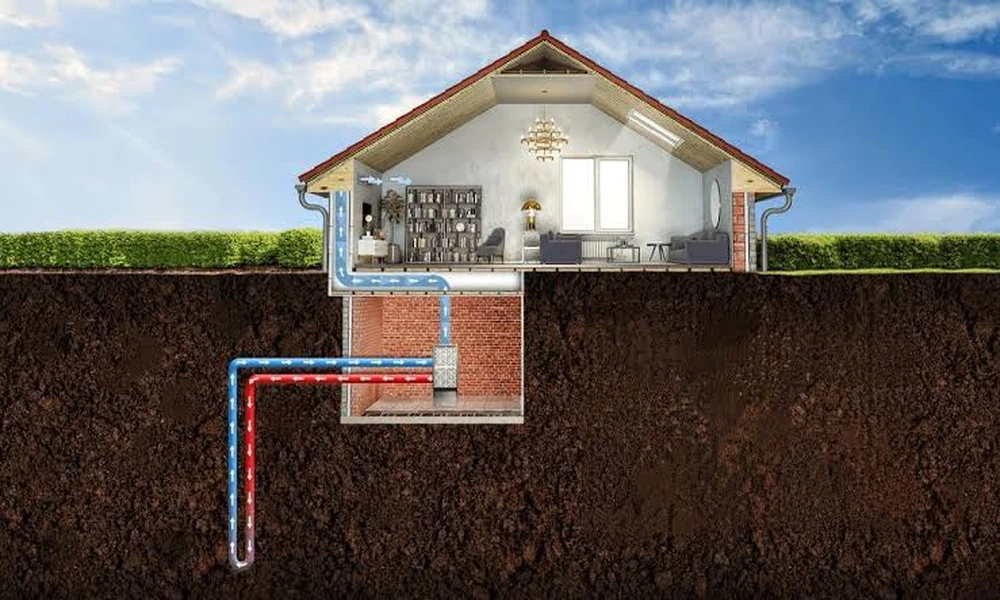
About six feet under a Jackson lawn, the soil sits close to 50 degrees all year. It barely notices when January drops below zero or when July pushes into the nineties. Geothermal heat pumps borrow that steady temperature, pulling warmth up from the ground in winter and pushing household heat back down in summer. The idea is simple. Whether it suits one particular house is a much harder question, and the answer usually depends on four things that rarely get looked at together.
Plenty of homeowners in the area put that question to Right Now Heat and Air before they commit to digging up a yard. The Jackson contractor works on ground source systems as well as the boilers, furnaces and ductless units that older Michigan homes already rely on, which makes it easier to weigh geothermal against what is sitting in the basement today. They also offer financing through Michigan Saves.
Those four things are the ground under the yard, the shell of the house, the way heat travels from room to room, and the money. Each one can make geothermal look brilliant or turn it into an expensive mistake.
What the Dirt Has to Say
The loop buried outside is the heart of the system and also its biggest cost. Southern Michigan soil is mostly glacial leftovers, a mix of sand, gravel and clay sitting over bedrock. Wet, packed soil moves heat well. Dry, loose sand moves it poorly, which means more pipe in the ground to collect the same amount of energy.
Lot size matters just as much. A rural parcel outside Jackson can usually fit long horizontal trenches, while a city lot near downtown often has room only for vertical bores drilled straight down. A pond on the property opens up a third option that costs far less to install.
| Loop type | What the property needs | How it tends to fit around Jackson |
|---|---|---|
| Horizontal trenches | A large open yard with no septic field or mature trees in the way | Common on acreage and newer rural builds |
| Vertical bores | Room for a drill rig and access for heavy equipment | The usual choice on tighter city and village lots |
| Pond loop | A pond deep enough that it will not freeze solid | Cheapest to install when the water is already there |
| Open loop | A strong well and a legal place to send the water afterward | Possible on some rural wells but needs careful testing |
A good installer will ask where the septic field, buried lines and future yard plans sit before sketching any loop.
A Leaky Shell Shrinks Any Savings
Geothermal equipment is sized to a home’s heat loss, and every extra unit of heat loss means more feet of pipe or drilling. A drafty 1920s house with little attic insulation might need a noticeably bigger loop than the same house after air sealing and new insulation.
That makes the order of work important. Sealing the attic floor, insulating the rim joists in the basement and fixing obvious drafts usually costs a fraction of the loop. Doing it first can shrink the system, cut the drilling bill and leave the house more comfortable no matter what heats it. A room-by-room load calculation should come before anyone quotes equipment.
Ducts and Radiators Decide the Comfort
Even with a perfect loop, the house still has to carry heat to the rooms. This is where many geothermal plans either succeed or fall flat.
Forced air homes. Geothermal air feels milder coming out of the register than air from a gas furnace, often in the 90s rather than well above 100 degrees. It makes up for that with steady, longer run times, but it needs more airflow to do it. Undersized or leaky ductwork, common in older houses that added central air decades ago, can leave rooms at the end of a run feeling chilly.
Boiler and radiator homes. Many older Jackson houses still heat with hot water running through cast iron radiators. Those radiators were designed for very hot water, often 160 to 180 degrees. A water-to-water geothermal unit runs most efficiently at much lower temperatures, so old radiators may not throw enough heat on the coldest nights. Radiant floors handle low water temperatures beautifully, and adding radiators or panel radiators can close the gap.
Homes with mixed or no distribution. Additions, finished attics and converted garages often sit outside the main heating system. These spaces sometimes pair better with a ductless unit than with a branch of the geothermal system.
Two other details belong in this conversation. Most geothermal units can include a desuperheater, which uses waste heat from summer cooling to warm the water heater for very little cost. And the electrical panel needs enough capacity for the heat pump plus any backup electric heat, which can mean a service upgrade in older homes still on smaller panels.
The Math After the Credit Disappeared
Whole-home geothermal commonly lands somewhere between $20,000 and $50,000 installed, with the loop driving most of the spread. Until the end of 2025, a federal tax credit covered 30 percent of that cost with no cap. The One Big Beautiful Bill Act ended that credit for expenditures made after December 31, 2025, so a $30,000 system that once came with roughly $9,000 back now comes with nothing from the federal side.
That changes the payback timeline, but it does not settle the question. Consumers Energy, which happens to be headquartered in Jackson, has offered rebates on qualifying heat pumps, and state electrification programs exist for income-qualified households. Amounts and rules shift, and some programs require approval before installation, so confirm them early.
What a home heats with now matters even more. A house on cheap natural gas will take longer to earn back the investment. A farmhouse burning propane or heating with old electric baseboard can see savings that make the numbers work much faster, especially when the same system replaces a worn-out central air conditioner at the same time.
Counting in Decades Instead of Winters
The EPA’s ENERGY STAR overview of geothermal heat pumps shows why these systems are judged on long horizons, with certified models using far less energy than standard equipment year after year. Industry estimates put the indoor equipment at about 25 years and the buried loop at 50 years or more. In practice the loop you install today may serve two or three heat pumps over its life, and future replacements only involve the equipment inside.
Timing can tilt the decision too. Pairing geothermal with new construction, a major landscaping project or a furnace that is already failing spreads the disruption and often the cost. Waiting for the furnace to die in February leaves little room for drilling and rarely leads to the best choice.
So the honest answer to whether a southern Michigan home suits geothermal is that it depends on the dirt, the walls, the pipes and the budget, weighed together rather than one at a time. When all four line up, few heating systems come close to its comfort and longevity. When one of them is badly out of step, fixing that piece first is usually the smarter move.
